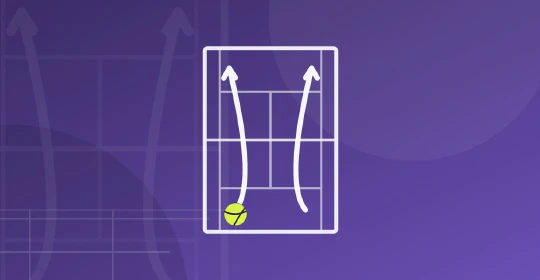
How to Beat an Aggressive Baseliner
If You Are a Counterpuncher

Playing against an aggressive baseliner is never easy. They cover the court well and always look for a chance to attack. If you try to out-hit them in a pure power contest, you are usually playing their favorite sport.
The better path - especially if you are a counterpuncher - is depth, variety of height and spin, and selective use of the short ball to drag them into places they do not love.
Know the style you are facing: Aggressive Baseliner.
Guidelines for the counterpuncher
-
Be patient and consistent. Be ready to be out there longer than normal. Their game thrives on your impatience.
-
Mix up the pace. Keep your risk profile down and build the point until you get a right chance to attack - using the low slice, the high above-the-shoulder ball, and other variety.
-
Make them generate their own pace. Many aggressive players prefer timing your pace. Take that gift away.
-
Depth is key. Pushing them back opens angles and creates the space you will eventually attack into.
-
Change direction down the line off the cross-court pattern. Groove this shot and own several methods to break the cross-court pattern:
- On-the-rise redirect
- Absorb and redirect
- Different height, spin, speed, and contact point
- Out of the air
- Low slice
-
Make them play where they are not comfortable - often at the net, or stretched wide on a short angle.
-
Keep the ball out of the strike zone - high and heavy, or low and short. Zone 2 is their office; close it.
-
Half-X: deep cross-court to short angle (and the reverse). Stretch the court in two dimensions.
-
Slow down the pace of the match. They normally like a higher tempo between points and inside the point.
Between-point tempo matters. If they want to play fast, you can still use your full time on changeovers and between points without gamesmanship theater - just refuse to be rushed into their rhythm.
What success looks like
You are not trying to “out-aggressive” the aggressor. You are trying to:
- Win more neutral exchanges than they do
- Force them to create from uncomfortable heights and positions
- Convert the first real short ball, not the fifth hopeful one
- Stay emotionally steady when they hit spectacular winners - those are priced into the matchup
Practice the matchup
- High / low only: no flat zone-2 balls for an entire set of cross-courts
- Depth gate: ball must land past the service line or it does not count as a successful neutral ball
- Short-angle + deep pattern games (Half-X)
- Live sets with one rule: you may only attack after a ball that lands short or after three quality deep balls
Key takeaway: Against the aggressive baseliner, patience is a tactic, not a personality trait. Depth, variety, and tempo control make them take the dangerous risk.
I hope this helps your preparation - and thanks to the USTA for the fantastic guidelines that shaped much of this framework.
For the reverse problem - when you need to break down a wall - see How to Beat a Counterpuncher.